
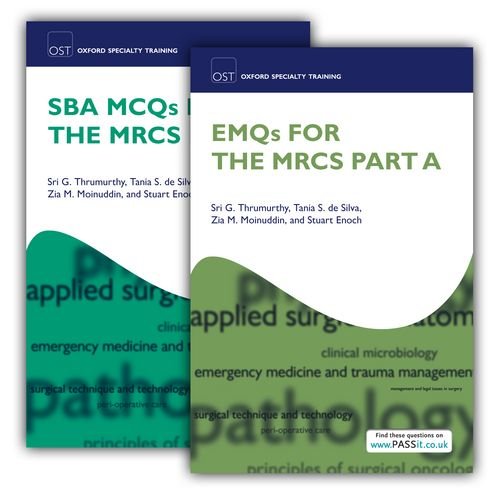
SBA MCQs and EMQs for the MRCS Part A Pack: 2 (Oxford Specialty Training: Revision Texts)
₹1,250.00
Specifically designed to help candidates revise for the MRCS exam, this two-volume pack features 350 Single Best Answer multiple choice questions, and 250 Extended Matching Questions, divided into 96 themes, covering the whole syllabus. Containing everything candidates need to pass the MRCS Part A, the pack focuses intensively on the application of basic sciences (applied surgical anatomy, physiology, and pathology) to the management of surgical patients. The high level of detail included within the questions and their explanations allows effective self-assessment of knowledge and quick identification of key areas requiring further attention. Varying approaches to Single Best Answer multiple choice questions are used, giving effective exam practice and guidance through revision and exam technique. This includes clinical case questions, positively-worded questions, requiring selection of the most appropriate of relatively correct answers; ‘two-step’ or ‘double-jump’ questions, requiring several cognitive steps to arrive at the correct answer; as well as factual recall questions, prompting basic recall of facts.
Related products
-

Puzzling Cases in Stroke
₹1,250.00Stroke is the leading cause of permeant disability , including post stroke dementia, pain, depression and personality changes. While large Clinical Trials reflect information about large stroke populations, the presentation of each and every stroke patient is individual and special. Currently there are only few books which illustrate case oriented discussion. This is unique book which includes common and unusual case of stroke, so as to reinforce diagnostic skills through careful analysis of individual presenting patterns, and to guide treatment decisions.
-

COVID – 19 VACCINES A Comprehensive Overview
₹1,595.00We are amid a pandemic that continues to smoulder almost everywhere with raging fire off and on at different places. It has not only devastated hundreds of thousands of families who lost someone to the virus and affected over 300 million people directly, it has affected all 7.9 billion of us in some way or other. At the same time, humanity has risen well to the pandemic challenges. It was realized very early during the current outbreal that safe and effcacious vaccines would be crucial in tackling the pandemic. The unprecedented global collaboration among all stakeholders: Scientists, pharmaceutical industry, funding agencies and Governments demonstrated what a global will could do: hundreds of vaccine candidates developed, and vaccine deployment started within 12 months of isolation of new virus something that takes over a decade otherwise.


-

How to Pass the MRCS OSCE (Vol 1 & 2)
₹1,400.00This is the only guide you need to pass the MRCS Part B OSCE examination. This unique two-volume set includes comprehensive revision notes on all the areas covered in the exam, numerous practice scenarios with model answers in the format they would be encountered in the exam, and essential exam technique tips. Written by a team of editors and authors with extensive experience of the exam and all the recent changes, it broaches topics that can often trip up the candidate, including communication and history-taking skills. Revision is aided by a multitude of images and illustrations, as well as boxes highlighting clinical tips and exam hints. Volume 1 covers basic surgical skills, including peri-operative care, as well as patient safety, history-taking, communication skills, applied surgical sciences and critical care. The book also provides tips on exactly how the examiners will expect you to approach the exam. Volume 2 addresses the stations that exam the four specialty areas: Trunk and Torso; Limbs and Spine; Head and Neck, and Neuroscience. It covers the anatomy, physiology and pathology in each of these four speciality areas along with detailed clinical exam scenarios and a bank of likely clinical questions and model answers.
-

Grand Rounds in Nephrology
₹2,295.00Thirty-six different case scenarios including clinical nephrology, dialysis and kidney transplantation have been discussed in this volume. Each case scenario is followed by a focussed discussion on a selected aspect in a question answer format. For this issue, eminent nephrologists from all over India have contributed and shared their vast knowledge and experience. This book will be useful to the residents in Nephrology who are preparing to take the examination as well as clinical nephrologists to revise and update their knowledge and skills. Training and ability to present the available data clearly and answering questions with reasonable self-assurance is important when taking a clinical examination or viva-voce. The cases selected are broad based, covering kidney diseases in children, glomerular diseases, non-glomerular kidney diseases, genetic disorders, acute kidney injury, chronic kidney disease, electrolyte abnormalities, dialysis and transplant related clinical scenarios.
-

Manual of Clinical Endocrinology 2/Ed.
₹995.00Algorithms provide a logical, concise and cost-effective approach to medical reasoning: utilizing a concise, step-by-step approach based upon clues from the history, physical examination and laboratory studies, algorithms help avoid excessive unnecessary procedures and testing. The 2nd edition of Manual of Clinical Endocrinology deals with practical issues ranging from simple thyroid function testing and thyrotoxicosis to approaching a patient with suspected thyrotoxicosis. Algorithms are simple and effective tools for the practitioner in a hurry and since the majority of the intended audience, physicians, general practitioners and postgraduates have very little time amidst their busy clinical routine, this manual uses algorithms. Twenty-two clinical issues are covered by an algorithmic approach, breaking down long lists and tables of differential diagnosis into smaller, more manageable ones. Common clinical symptoms, signs and laboratory abnormalities are classified as they present themselves at the patient’s bedside. This manual is an attempt to provide the busy practitioner with a desktop reckoner which will be useful while approaching a patient with a suspected endocrine problem. The authors have strived to be practical not pedantic – at the same time have made great effort to ensure that the recommendations are evidence based.
-

Puzzling Cases in Stroke Vol. 2
₹1,695.00Stroke is a treatable medical emergency affecting about 15 million people every year worldwide. It is the most common cause of common cause of disability globally and is the third most common cause of death. In the present times, there are effective treatment options which if given timely will benefit the patients of stroke remarkably. Therefore, correct diagnosis of acute stroke is extremely important for the clinicians to provide appropriate treatments and to ensure prevention of acute complications, including recurrent strokes. But sometimes a typical or uncommon presentation of stroke or “stroke chameleons”can lead to diagnostic dilemma. Therefore, timely diagnosis and management may be delayed. There are time – tested strategies which when strictly followed by the Neurphysician can reduce the chances of missing the correct diagnosis. Firstly, “Listen very carefully to the patient. He is telling you the diagnosis.” Clinicians should suspect stroke when the history suggests abrupt onset of neurological symptoms. Remember, Stroke is a clinical diagnosis and imaging is providing the corroboratory evidence. Secondly, a complete and systematic neurological examination should be routinely done in patients presenting with acute neurological symptoms because this might shed light on the true nature of the problem. Finally, even the most sophisticated neuroimaging tests might miss the stroke in the early hours after the event.
-

EMG Simplified
₹3,250.00ABOUT THE BOOK – A concise book for practical Electroneuromyography What is it for? Electrodiagnosticians Neurology trainees Neurology practitioners Orthopedic and hand surgeons Physicians Technologists COVERS Technical as well as neurological aspects Troubleshooting paradigms Approach based on presenting symptoms Disease based discussions Considerations about the common and the uncommon Case Studies
-

CARDIAC MRI Simplified CONCISE GUIDE
₹625.00Who Will benefit from this book? * Genuine interest in cardiovascular imaging * International certification exams * Enhancing skills in interpretations of cardiac MR Why this format? * Salient points, easier and faster to read. * Questions-answer approach for better understanding of topic. * Short and well contained guide. What are the highlights of the book? * Comprehensive coverage of all topics * Appropriate illustrations * Inclusion of recent advances